
Five things I believe.
Not a manifesto. Not a framework. Nope, it’s the ideas that shape how I lead, how I design, and how I decide what matters.
01
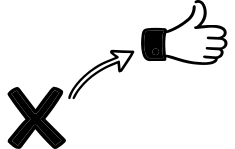
Wrong first,
right later.
The fastest way to a good answer is starting with a less than ideal one. My teams make something – anything – early, so stakeholders and users are reacting to reality instead of debating boxes on a whiteboard. A filled-with-assumptions prototype teaches faster than a perfect brief.
02

Lean into
the overlaps.
The most interesting work happens at the edges, where design meets engineering, where product meets strategy, where user need meets business model. Teams collaborate better when they don’t always stay in their lanes but still defer to the experts when push comes to shove.
03
AI is a
catalyst.
AI doesn't replace the designer, it shortens the distance between thinking and making. To be successful, teams must use it to compress the loop: idea to prototype to decision, rinse, repeat. It’s a new, super quick way to communicate a solution that anyone can use. That speed changes what's possible, how you work with stakeholders, and what you're willing to try.
04

It's business
time.
Design is only as good as its business impact. Beautiful work that doesn't move a metric, shift a behavior, or change a conversation is wallpaper. Teams must understand both the user’s needs and the business needs and be truly accountable to outcomes.
05

Happy people do better work.
This may sound soft unless you've seen the alternative. Psychological safety, clear purpose, and genuine care for people aren't nice-to-haves, they're the conditions needed for repeatable great work to happen.
Eric Sagalyn
Five things I believe.
Not a manifesto. Not a framework. Nope, it’s the ideas that shape how I lead, how I design, and how I decide what matters.
01
Wrong first,
right later.
The fastest way to a good answer is starting with a less than ideal one. My teams make something – anything – early, so stakeholders and users are reacting to reality instead of debating boxes on a whiteboard. A filled-with-assumptions prototype teaches faster than a perfect brief.
02
Lean into
the overlaps.
The most interesting work happens at the edges, where design meets engineering, where product meets strategy, where user need meets business model. Teams collaborate better when they don’t always stay in their lanes but still defer to the experts when push comes to shove.
03
AI is a
catalyst.
AI doesn't replace the designer, it shortens the distance between thinking and making. To be successful, teams must use it to compress the loop: idea to prototype to decision, rinse, repeat. It’s a new, super quick way to communicate a solution that anyone can use. That speed changes what's possible, how you work with stakeholders, and what you're willing to try.
04
It's business
time.
Design is only as good as its business impact. Beautiful work that doesn't move a metric, shift a behavior, or change a conversation is wallpaper. Teams must understand both the user’s needs and the business needs and be truly accountable to outcomes.
05
Happy people do better work.
This may sound soft unless you've seen the alternative. Psychological safety, clear purpose, and genuine care for people aren't nice-to-haves, they're the conditions needed for repeatable great work to happen.
Eric Sagalyn